
The First Week of Home Care: What Families in Port St. Lucie Should Expect and How to Prepare
A practical, reassuring guide to preparing for an in-home caregiver’s first visits
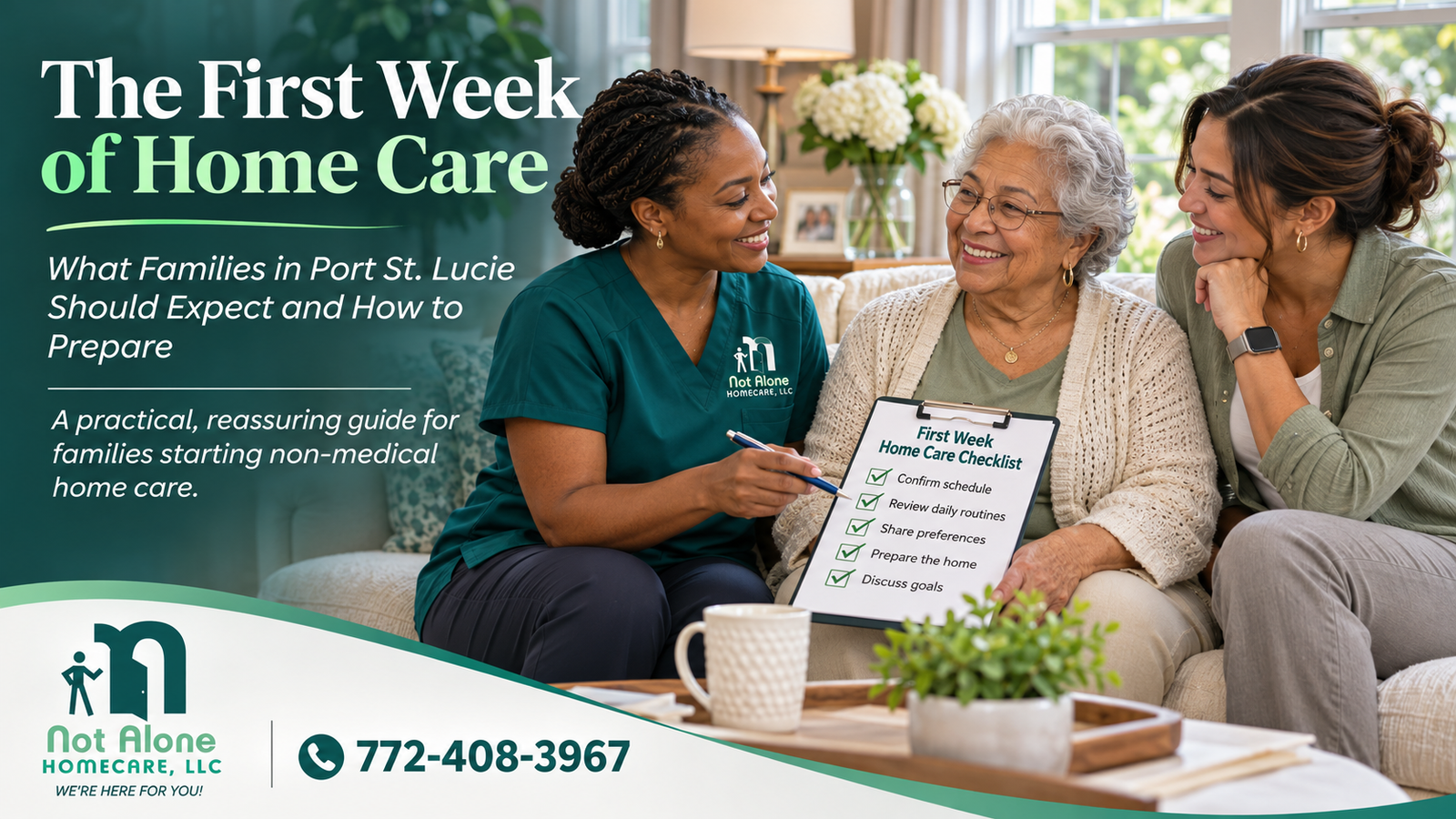
The first caregiver visit is tomorrow, and you are not sure what you should have ready.
Maybe you arranged help after noticing your mother skipping meals, or because your father’s shower started to feel risky. Either way, the decision is made — and now a stranger is about to walk through your parent’s door. It is normal to feel a mix of relief and worry: relief that support is coming, and worry about whether your loved one will accept it, whether you have prepared enough, and how the first few days will actually go.
This guide is here to help you through that first week. It is written for adult children, spouses, and family caregivers in Port St. Lucie, Fort Pierce, and across St. Lucie County, and it focuses on what you can do before and during the initial visits — not on when or why to start care, which our article on the signs an aging parent may need extra help already covers. If your loved one is returning from a hospital stay, our guide to hospital discharge and home care addresses additional recovery-specific considerations; this article focuses on adjusting to a new in-home caregiver.
It is educational and general, not medical advice, and not a description of any official agency onboarding process. Specific arrangements — services, schedules, caregiver responsibilities, and how introductions are handled — must always be confirmed directly with the care provider. To learn about the private-pay non-medical home care we provide, visit our services page.
Quick Answer
Preparing for the first week of home care generally involves five things: understanding your loved one’s daily routines and preferences, discussing the appropriate non-medical tasks with the care provider, organizing household and emergency information, setting clear communication expectations with family, and reviewing how the initial visits go so small adjustments can be made early. The first week is rarely about getting everything perfect — it is about building comfort, clarity, and trust between your parent, the caregiver, and your family.
What Should Families Expect During the First Week of Home Care?
The first week of home care is usually a period of introductions, observation, and gentle adjustment rather than a fully settled routine. A caregiver is meeting your loved one for the first time, learning the layout of the home, and getting a sense of how your parent likes things done. Your parent, in turn, is deciding how they feel about having someone new in their space.
In practice, the first several visits often involve:
- Introductions and orientation — meeting the caregiver, walking through the home, and reviewing the agreed tasks.
- Understanding routines — observing how your parent’s day usually unfolds and where help fits in.
- Clarifying expectations — confirming which services are included and which are not.
- Making adjustments — small changes to timing, approach, or tasks as everyone settles in.
This is general preparation guidance, not an official Not Alone Homecare onboarding process. How introductions, scheduling, and caregiver assignments are actually handled must be confirmed directly with the care provider, since arrangements vary by family and by agency.
Before the First Visit: What Should You Prepare?
A little preparation goes a long way. You do not need a formal document — a few handwritten notes are often enough. The goal is to give the caregiver the everyday context they need to help well, while protecting your loved one’s privacy and dignity.
Use this checklist as a starting point:
You are not asked to publicly share protected medical information. Keep detailed health records in a secure place at home, and share only the everyday context the caregiver needs to perform the agreed non-medical tasks.
How to Introduce a New Caregiver to an Aging Parent
The introduction often shapes how the whole first week feels. The most important principle is to give your loved one a voice. When your parent feels that they are part of the decision rather than the subject of it, acceptance comes more easily.
- Explain why assistance is being arranged — honestly and without alarm.
- Start with familiar routines — a morning coffee or a favorite activity, not an unfamiliar task.
- Respect privacy and preferences — let your parent guide what they share.
- Avoid pressure or confrontation — if your parent is reluctant, slow down rather than push.
- Help family members communicate expectations — agree in advance on who will say what.
For example, in a hypothetical first visit, a daughter introduces the caregiver to her mother and invites her mother to share how she likes her morning tea and breakfast. Together they confirm that meal preparation and companionship are the agreed daily tasks, and ask the care provider about anything outside that plan. This is an illustration, not a real client experience.
These short, illustrative examples show the tone — they are not real client stories:
“Mom, this is Maria. She’s going to come by a few mornings a week to help with breakfast and keep you company. I’ll be here today so you can get to know her.”
“Dad, remember we talked about the shower feeling a little unsteady? James is here to help with that, and only that, for now. Nothing else changes unless you want it to.”
“You don’t have to do anything you’re not comfortable with. If today is just having a cup of tea together, that’s a fine start.”
If your parent is pushing back on the idea of care itself, our guide to responding when an aging parent refuses home care offers respectful ways to keep the conversation open.
What Can a Non-Medical Home Caregiver Help With?
Knowing what a caregiver can and cannot do helps you set realistic expectations for the first week. Non-medical home care supports everyday living — it is not skilled healthcare.
Common non-medical service categories include:
- Companionship — conversation, shared activities, and a friendly presence.
- Personal care — assistance with bathing, grooming, and dressing.
- Bathing and grooming assistance — respectful help with personal routines.
- Meal preparation — planning and cooking meals to your parent’s preferences.
- Light housekeeping — keeping walking paths clear and living spaces tidy.
- Homemaker assistance — laundry, errands, and household tasks.
- Medication reminders — prompting a senior to take medicine at the right time.
- Mobility assistance — helping a senior stand, walk, or move between rooms, within appropriate service limits.
- Respite assistance — giving family caregivers a planned break.
Not every family needs every service. The first week is a good time to confirm which tasks are actually part of your arrangement. It is just as important to understand the boundaries: non-medical caregivers do not provide skilled nursing, rehabilitation, medical diagnosis, or medication administration. A caregiver can offer a medication reminder, but giving, injecting, or adjusting medications is a clinical task for a licensed professional. To compare two common service types in detail, read our guide to companion care vs. personal care.
Before, During, and After the First Caregiver Visits
The table below walks through the first week stage by stage, with practical things families can prepare or discuss and why each one matters.
| Stage | What Families Can Prepare or Discuss | Why It Matters |
|---|---|---|
| Before the first visit | Write down your loved one's daily routine, meal and bathing preferences, emergency contacts, household access details, and the non-medical tasks you hope to have supported. Confirm the agreed schedule and services with the care provider. | A clear, written summary helps the caregiver step in confidently and reduces misunderstandings on day one. |
| Initial caregiver introduction | Greet the caregiver together with your loved one, explain why assistance is being arranged, and let your parent share a few preferences in their own words. | A warm, unhurried introduction sets the tone and helps your parent feel like a participant rather than a patient. |
| First daily routine | Walk through the routine the caregiver will help with, point out where supplies are kept, and clarify which tasks are included and which are not. | Seeing the routine in action surfaces small details, such as preferred mug or bathroom setup, that written notes often miss. |
| Communication with family | Agree on how and how often the family will receive updates, and who the caregiver should contact with questions. | A simple communication plan keeps everyone informed without overwhelming your loved one or the caregiver. |
| Reviewing preferences | After a few visits, note what is working well and what feels uncomfortable, and share that feedback with the care provider. | Preferences often become clearer once care begins; early adjustments prevent small frictions from growing. |
| End-of-week discussion | Talk with your loved one and the care provider about whether the agreed tasks are being met, whether the schedule feels right, and whether any changes are needed. | A deliberate end-of-week check-in turns the first week into a foundation rather than a fixed arrangement. |
What If the First Few Visits Feel Uncomfortable?
It is common for an older adult to feel unsure around someone new, even when the caregiver is kind and capable. A first visit can feel awkward, and that awkwardness does not mean the arrangement is wrong. It often simply means two people are still getting to know each other.
A few things can help:
- A parent feeling unsure around someone new — give it a little time and keep routines familiar.
- Different communication styles — some caregivers are chatty, others quiet; neither is wrong.
- Routine adjustments — small changes to timing or approach often ease friction.
- Clarifying misunderstood expectations — confirm which tasks were actually agreed.
- Raising concerns respectfully — name the specific issue rather than letting it build.
- When to contact the care provider — if discomfort continues, share what you are seeing and ask about options.
Do not assume every difficulty resolves on its own. If something feels wrong, it is worth a calm, specific conversation with the care provider — whether that means adjusting the routine, clarifying expectations, or asking whether a different caregiver match may be possible.
What Should Families Review After the First Week?
The end of the first week is a natural point to step back and ask how things are going. A short, honest review helps you decide whether to continue as-is or make changes.
Useful questions to ask include:
- Is the assistance addressing the intended daily tasks?
- Does the older adult feel respected?
- Are expectations clear for everyone involved?
- Are there concerns requiring follow-up?
- Is the agreed schedule appropriate?
- Is a different type of assistance potentially needed?
Share what you learn with the care provider so adjustments can be discussed. This article does not prescribe a particular number of care hours or promise scheduling flexibility — those depend on your family’s arrangement and what the provider can confirm. If you are weighing different levels of support, our comparison of respite care vs. 24-hour home care may help.
When Non-Medical Home Care Is Not Enough
Non-medical home care is valuable, but it has clear limits. It supports everyday living — companionship, personal care, meals, light housekeeping, medication reminders, and mobility assistance. It does not replace skilled healthcare.
Skilled home health care is clinical care ordered by a physician and provided by licensed professionals — nursing, therapy, wound care, and medication administration. These are separate from the everyday assistance a non-medical caregiver provides. Not Alone Homecare, LLC does not diagnose medical conditions, provide skilled nursing, or administer or manage medications.
For new, sudden, severe, or worsening medical symptoms — chest pain, difficulty breathing, a serious fall, sudden confusion, or signs of a stroke — contact an appropriate healthcare professional or call 911 right away. A non-medical home care agency is not a substitute for emergency services or medical evaluation.
Preparing for Home Care in Port St. Lucie and St. Lucie County
Not Alone Homecare, LLC is a Florida licensed non-medical home care agency (AHCA License #299995616) serving families in Port St. Lucie, Fort Pierce, and across St. Lucie County. If you live in nearby communities such as Stuart, Palm City, or Jensen Beach, those areas fall within our broader Treasure Coast service region as well.
Local families can review available non-medical care services and contact us to discuss their situation with no obligation. We can listen, explain what non-medical home care includes, and help you understand your options. We cannot guarantee caregiver availability, a specific schedule, or an immediate start date, but we can help you think through your next step.
To learn more, explore home care in Port St. Lucie, home care in Fort Pierce, and home care throughout St. Lucie County. If you are still comparing providers, our article on questions to ask before choosing a home care agency can guide the conversation.
Related Reading for Families
About This Article
Agency attribution: Prepared by Not Alone Homecare, LLC — a licensed Florida non-medical home care agency (AHCA License #299995616) serving Port St. Lucie, Fort Pierce, and the Treasure Coast.
Published: November 1, 2026. This article provides general educational information only and is not medical, legal, or financial advice. It describes general preparation guidance, not an official agency onboarding, assessment, matching, supervision, or follow-up process. Not Alone Homecare, LLC does not diagnose medical conditions, provide skilled nursing care, administer or manage medications, or guarantee caregiver availability, acceptance, a specific schedule, or an immediate start date. Always contact an appropriate healthcare professional for concerns about health or cognition, and call 911 for any emergency.
Sources: National Institute on Aging, Caregiving; Eldercare Locator (Administration for Community Living), eldercare.acl.gov.
Contact: 772-408-3967 • notalonehomecare.com
Frequently Asked Questions
What should families prepare before the first home care visit?
Gather a simple summary of your loved one's daily routine, bathing and dressing preferences, meal preferences and any dietary instructions supplied by the family or a healthcare professional, household access details, emergency contacts, communication preferences, and relevant mobility considerations. Keep private medical records stored securely and share only what the caregiver needs to perform agreed non-medical tasks. Confirm the specific services, schedule, and caregiver responsibilities directly with the care provider.
Should an adult child be present when a caregiver first arrives?
It is often helpful for a familiar family member to be present for the first visit, especially if the older adult is uneasy about meeting someone new. Being there can ease introductions, help explain preferences, and let your loved one see that you trust the arrangement. Whether someone stays for later visits depends on your parent's comfort and the family's circumstances, and can be discussed with the care provider.
What if an aging parent feels uncomfortable with a new caregiver?
Some discomfort is normal in the first few visits. Give the relationship a little time, keep routines familiar, and avoid pressuring your parent. If the discomfort continues, note what specifically feels off, raise it respectfully with the care provider, and ask whether a different approach or caregiver match may be possible. Respect your parent's voice throughout. If refusal persists, continue to honor their autonomy and revisit the conversation later.
What daily tasks can a non-medical caregiver assist with?
A non-medical caregiver can help with companionship, personal care such as bathing, grooming, and dressing assistance, meal preparation, light housekeeping, homemaker assistance, medication reminders, mobility assistance within appropriate service limits, and respite support for family caregivers. Not every family needs every service. Non-medical caregivers do not provide skilled nursing, medical treatment, diagnosis, or medication administration.
How can families communicate their loved one's preferences?
Write down the details that matter most, such as how your parent likes their morning routine, foods they enjoy or avoid, words or topics that upset them, and how they prefer to be addressed. Share a concise version with the caregiver and the care provider, and invite your parent to speak for themselves whenever possible. Keep the list current as routines and preferences change.
What should families review after the first week?
Ask whether the assistance is addressing the intended daily tasks, whether your loved one feels respected, whether expectations are clear, whether any concerns need follow-up, whether the agreed schedule is appropriate, and whether a different type of assistance may be needed. Share what you learn with the care provider so adjustments can be discussed. Do not assume every concern resolves on its own.
What is the difference between non-medical home care and skilled home health care?
Non-medical home care supports everyday living, such as companionship, personal care, meal preparation, light housekeeping, medication reminders, and mobility assistance. Skilled home health care is clinical care ordered by a physician and provided by licensed professionals, such as nursing, therapy, wound care, and medication administration. Not Alone Homecare, LLC provides non-medical home care only and does not diagnose, treat, or administer medications.
How can families in Port St. Lucie request home care information?
Families in Port St. Lucie, Fort Pierce, and St. Lucie County can request care information through the Not Alone Homecare Contact page or by calling 772-408-3967. We can listen to your family's situation, explain what non-medical home care includes, and help you understand your options. We cannot guarantee caregiver availability, a specific schedule, or an immediate start date, but we can help you understand your next step. Visit our Contact page to get started, or explore our services and FAQ page.
Preparing for Home Care? You Don’t Have to Figure Everything Out Alone.
We’re Here for You! If you are getting ready for a caregiver’s first visit — or still deciding whether home care is the right step — Not Alone Homecare, LLC is glad to listen. Contact us to discuss non-medical assistance and learn about available services in Port St. Lucie, Fort Pierce, and St. Lucie County. We cannot guarantee caregiver availability, a specific schedule, or an immediate start date, but we can help you understand your next step.
Licensed Non-Medical Home Care Agency • AHCA License #299995616
Have more questions? Visit our FAQ page.